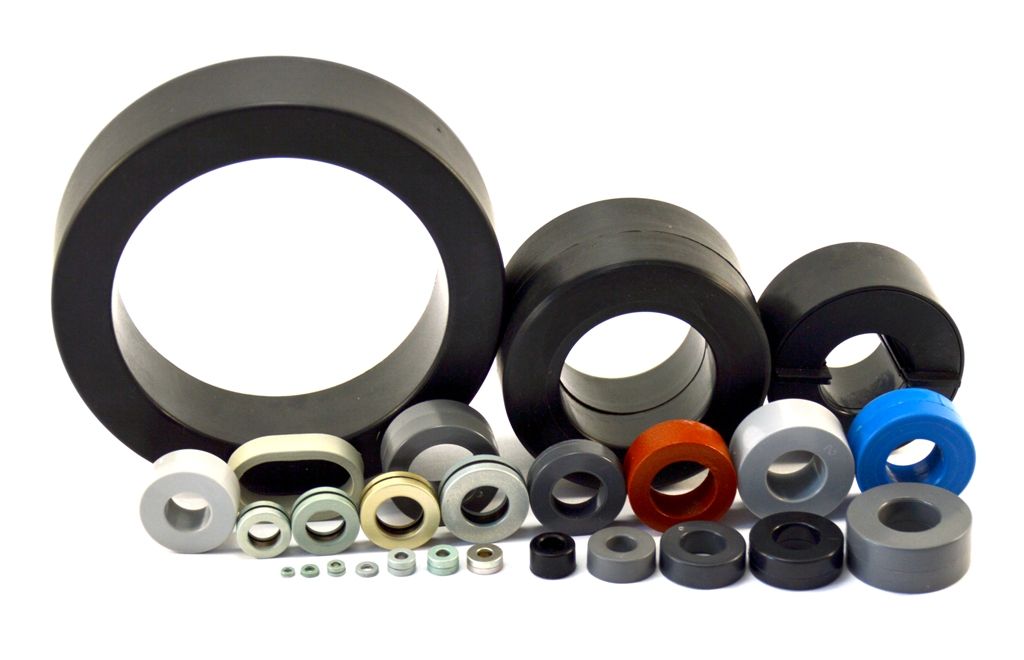
Amorphous cores and nanocrystalline cores are both advanced soft magnetic materials used in high-efficiency transformers, current transformers, inductors, and power electronic applications. The main difference lies in their material structure, magnetic properties, and typical applications.
Amorphous cores are made from rapidly solidified iron-based amorphous alloy ribbons. The atoms are arranged in a non-crystalline structure, which eliminates grain boundaries and provides excellent magnetic performance.
Nanocrystalline cores are produced by heat-treating amorphous alloy ribbons to create an ultra-fine crystalline structure with nano-sized grains. This structure provides higher permeability and improved magnetic characteristics.
| Feature | Amorphous Core | Nanocrystalline Core |
|---|---|---|
| Material Structure | Non-crystalline alloy | Nano-crystalline alloy |
| Core Loss | Very low | Extremely low |
| Magnetic Permeability | High | Very high |
| Saturation Flux Density | Higher | Medium |
| Frequency Performance | Good | Excellent |
| Temperature Stability | Excellent | Excellent |
| Cost | Lower | Higher |
Amorphous cores are mainly used where low energy loss and high efficiency are required:
Distribution transformers
Energy-saving transformers
Current transformers (CT)
Voltage transformers (PT)
Power monitoring equipment
Advantages:
Lower core loss compared with traditional silicon steel
High energy efficiency
Suitable for power frequency applications (50Hz/60Hz)
Nanocrystalline cores are preferred for applications requiring high permeability, high frequency performance, and excellent sensitivity:
High-frequency transformers
Common mode chokes
EMI filters
Precision current transformers
Renewable energy equipment
EV charging systems
Inverter applications
Advantages:
Extremely high permeability
Excellent frequency characteristics
Low magnetic loss
Compact design capability
The choice between amorphous and nanocrystalline cores depends on your application requirements.
Choose amorphous cores when you need:
✔ Low cost
✔ High energy efficiency
✔ Distribution transformer applications
✔ 50Hz/60Hz operation
Choose nanocrystalline cores when you need:
✔ Higher permeability
✔ Better high-frequency performance
✔ Precision measurement
✔ EMI suppression
✔ Compact magnetic components
Both amorphous and nanocrystalline cores provide significant advantages over conventional silicon steel cores. Amorphous cores are ideal for energy-efficient power transformers, while nanocrystalline cores offer superior magnetic performance for high-frequency and precision applications.
As a professional manufacturer of amorphous cores, nanocrystalline cores, and transformer magnetic cores, Hefei Ruyue Electric Technology provides customized soft magnetic core solutions based on customer requirements.
Contact: Ms. Ge
Phone: 86-13965137578
E-mail: sales@softmagneticcore.com
Add: No78 Jieshou Road,Hefei City 230001, P.R,China
LiveChatclose



 Send Email
 WhatsApp